Essay
From Shame to Sovereignty
Exploring Our Capacity for Pleasure, Presence, and Freedom
Alex Sloan | Queer Sovereignty Method
Download PDFWe are living in a remarkable moment. For those of us fortunate enough to be able to shape our lives more fully on our own terms, particularly in how we experience pleasure, create relationships, and express our sexuality, the possibilities are extraordinary. These are freedoms that many queer people throughout history, and many today, have not enjoyed. And we are only beginning to discover what we might do with them.
Queer people are creating relationships and communities that do not have to follow inherited narrow definitions about sexuality, gender, masculinity/femininity, intimacy, domesticity, or belonging. We can explore and express more authentic ways to love, form chosen family, share power, explore erotic life, and express who we are. There is joy in that experimentation: not a single queer way to live, but more room to discover what feels true.
And yet outer freedom does not automatically become inner freedom. A queer person can know they are free to choose and still feel their body tighten at being seen, asking for what they want, receiving pleasure, or expressing something that once felt unsafe. The familiar habits of contraction and self-editing can remain long after the world around us has opened.
There are also moments when those habits tend to soften. In experiences that feel safe, pleasurable, and welcoming, whether in intimacy, erotic connection, community, or creative expression, a person may discover an extraordinary openness, confidence, playfulness, or ease.
For a moment, freedom is not an idea. It is something the body knows.
The Queer Sovereignty Method begins with curiosity about those moments. What if this freer way of being is not a temporary exception or a different self, but evidence of a real capacity already present? What helps that capacity emerge, and how might we carry more of it into our relationships, work, creativity, communities, and everyday lives? This inquiry has grown especially from my work with gay men, while the patterns it explores certainly belong to a wider queer and even human-wide experience.
What becomes possible when the freedom we glimpse in pleasure begins to shape the rest of our lives?
How Shame Becomes Embodied
Many queer men grow up learning that some part of who we are is unacceptable. Sometimes the messages are explicit. Often they arrive more quietly: a parent's discomfort with our sensitivity, a joke at our expense, disapproval of our mannerisms, or the feeling that our natural enthusiasm is somehow too much.
Over time, we learn which parts of ourselves are welcome and which might threaten acceptance. We become careful about how we speak, move, express affection, and reveal ourselves. These strategies may have protected belonging, dignity, or safety. The opportunity is not to shame ourselves for having them. It is to notice when an old protection is governing a present moment and create more capacity to choose how we respond.
Shame is not simply an unpleasant thought. It appears in the held breath, the tightening chest, the shoulders drawn inward, the gaze that drops, the sudden wish to leave. A man may know perfectly well that his sexuality is nothing to be ashamed of and still feel anxious about expressing desire, being seen naked, or receiving affection.
We may understand intellectually that we are safe, worthy, and deserving of pleasure, while our bodies continue to respond as though something about us needs to be hidden.
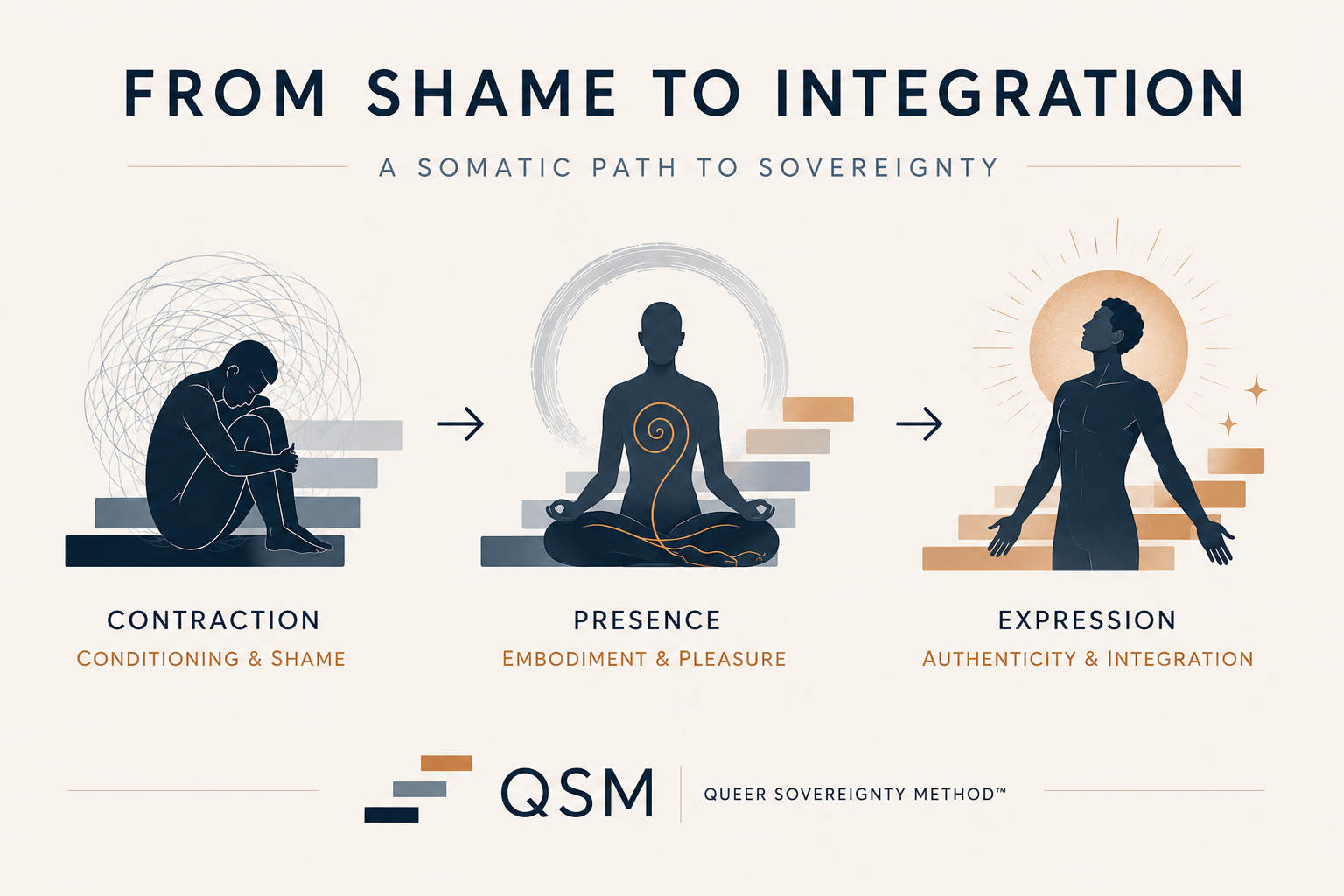
That is why embodied experience matters. When someone encounters acceptance where he expected rejection, or remains present in an experience that once triggered shame, he has an opportunity to learn something new.
Relational safety is not a guarantee that nothing difficult will happen. It is the felt possibility that we can stay connected to ourselves, communicate, make choices, and be met with care.
Pleasure Offers Another Experience of Ourselves
Sexuality is one of the places where shame has often been most deeply reinforced. We judge our bodies, compare ourselves with others, question our desirability, and monitor whether our desires are acceptable. Even during sex, we may be more concerned with how we appear than with what we are actually experiencing.
Yet erotic pleasure can offer one of the most direct opportunities to experience ourselves differently. Consider masturbation. Alone and free from the immediate judgment of others, we may devote time and care to discovering what feels good. We explore sensation, imagination, fantasy, and desire. Beyond physical stimulation, we are exercising agency over our own pleasure, giving ourselves attention, and allowing our bodies to receive something we enjoy.
This does not require us to love how our bodies look. A person may carry significant body shame and still deeply appreciate how their body feels during pleasure.
We do not have to love everything about our bodies to appreciate the extraordinary pleasure they allow us to experience.
Shared erotic experience introduces another dimension. Being touched with care, naming a desire and having it welcomed, receiving attention without judgment, or allowing someone to witness our pleasure can challenge deeply held expectations about vulnerability and acceptance. At their best, queer, kink, and other sex-positive communities deliberately cultivate consent, affirmation, bodily autonomy, and the freedom to be seen without apology.
Through pleasure, we can discover something powerful about ourselves. As we become more aware of what we're feeling in our bodies, we may recognize confidence, courage, openness, and a sense of personal power that we don't always experience elsewhere. These aren't simply pleasurable sensations. They can be expressions of our erotic agency, offering a different understanding of who we are and what we're capable of than the stories we absorbed and came to believe about ourselves when we were younger. And perhaps most importantly, we can begin to explore how to bring those same capacities into our relationships, work, and everyday lives.
When Confidence Changes With Context
Some of the most striking examples emerge when we notice how differently the same person can express himself in ordinary social life and in embodied erotic practice.
I have encountered men who seem uncomfortable in ordinary social situations: reserved, anxious, reluctant to attract attention, and carefully managing how they are perceived. During individual or shared erotic pleasure, those same men can become remarkably expressive. In these settings, they may appear confident, physically open, playful, powerful, and entirely comfortable receiving attention.
What is especially striking is that these are often environments involving considerable vulnerability. A man may be naked and visibly aroused in the company of people he barely knows, yet experience a greater sense of ease and acceptance than he would at an ordinary social gathering.
The surrounding conditions help explain this apparent contradiction. Where pleasure, desire, and bodily expression are welcomed, and where participants offer affirmation, mirroring, and appreciative attention, ordinary expectations of judgment or rejection may begin to soften.
The person’s underlying capacity for confidence has not necessarily changed, but his sense of safety expressing it has. What emerges can be spontaneous. He does not need to imagine or perform a more confident self. He is already experiencing that confidence, sometimes with an intensity that would have seemed unimaginable elsewhere.
We tend to think of confidence, openness, and self-expression as stable characteristics of personality. Someone describes himself as shy, socially anxious, sexually inhibited, or uncomfortable being seen, and gradually these descriptions become part of his understanding of who he is.
Yet an experience of extraordinary freedom in another environment suggests that these characteristics may be more dependent on context than we recognize.
The confidence we experience in pleasure is real. So are the openness and personal power we may discover there.
That does not mean the shift will automatically follow us home. But experiencing ourselves as expressive, powerful, and accepted in safe company can change how we understand who we are. It can challenge old stories about ourselves and give us a lived reference point when familiar instincts tell us to retreat into self-protection.
This is the question that stays with me: if a shy or self-conscious man can experience himself as open, magnetic, and unguarded in one setting, what exactly has been revealed? Is the confident version less real because it appeared in pleasure, or has pleasure allowed a real capacity to emerge under different conditions? And what might become possible if he learned to access that same confidence, agency, and personal power in other parts of his life?
What the Body Is Showing Us
Pleasurable and even ecstatic experiences are not simply unusually happy emotional states. There's a growing body of research in neuroscience, psychology, and psychotherapy supporting this understanding of how we learn and change.
Our nervous systems adapt to our experiences, developing familiar patterns of protection that can become deeply ingrained over time. But these adaptations are not necessarily permanent. New experiences of safety, acceptance, and authentic expression can help us break free from those patterns, even when old protective instincts remain. This is part of what makes embodied exploration so interesting. We're not simply thinking differently about ourselves. We're giving our bodies opportunities to experience something different, gradually freeing ourselves from the automatic reactions that once caused us to contract, perform, or hide.
Pleasure itself involves real changes in how our brains and bodies process sensation, attention, emotion, reward, and awareness. Dopamine contributes to anticipation, motivation, and reward learning. Endorphins and endocannabinoids participate in pain regulation, mood, and pleasurable sensation. Oxytocin is involved in bonding and intimate connection, while serotonin contributes to mood, perception, and many dimensions of brain function.
None of these chemicals is a single switch for pleasure, happiness, or transcendence. Their effects emerge through complex interactions with our nervous systems, histories, expectations, and surroundings. In deep absorption, ordinary internal commentary may become quieter. We may spend less attention evaluating our appearance or anticipating what others think. Time can seem to change, bodily sensations become vivid, and our usual sense of separation may soften.
Meditation and certain psychedelic-enhanced states are also studied for changes in attention, self-awareness, perception, and communication among brain networks. The pathways and experiences are not identical to erotic stimulation, and they should not be collapsed into one another. The lighter comparison is still useful: our bodies and minds possess capacities for pleasure, absorption, connection, and altered awareness that everyday life may only partially reveal.
Sexual activity is especially interesting as an embodied practice because it can engage sensation, imagination, anticipation, reward, vulnerability, body image, memory, desire, and relational connection at once. This does not make every intense experience meaningful or healing. It does suggest that pleasure can be approached with curiosity, intention, awareness, and appropriate care.
What makes this especially interesting is that our nervous systems are capable of learning from new experiences. The same bodies that learned to contract, perform, or hide can also develop greater familiarity with safety, openness, and authentic expression.
Pleasure as a Laboratory for Self-Discovery
What interests me most about these experiences is not simply how extraordinary they can become, but what they might teach us about ourselves.
Our bodies are constantly providing information about how we are experiencing the world. We notice tension, hesitation, excitement, attraction, discomfort, and the instinct to protect ourselves, often before we can explain what we are feeling. Much of our work around shame involves learning to recognize those familiar patterns of contraction and self-protection.
But what about the other side of that experience? What can we learn from the moments when our bodies feel open, welcomed, confident, connected, and genuinely alive?
Breathwork, self-touch, consensual touch with others, sensual exploration, and erotic pleasure can all offer opportunities to investigate these questions directly. We do not necessarily need extraordinary intensity. A gentle touch, an appreciative gaze, the pleasure of receiving attention, or the experience of naming a desire and having it welcomed may be enough to reveal something we had not previously recognized.
At other times, sustained erotic pleasure or ecstatic experience can bring us into extraordinary states of absorption, vulnerability, and expression. These experiences all belong to the same broad continuum of embodied exploration, even though their intensity and effects may differ dramatically.
What makes them particularly interesting is that we are not merely examining our limitations. We are having direct, pleasurable experiences of capacities we may want to access more fully in other parts of our lives. We can feel what confidence is like in our bodies. We can experience being seen without performing, expressing desire without apology, or receiving affection without immediately questioning whether we deserve it.
With sufficient awareness, choice, and relational safety, these moments can offer new information and new reference points for what is possible. They do not erase the patterns we have learned, and pleasure itself is not proof that we are acting authentically. But they give us something valuable to explore alongside fear, shame, and contraction: real experiences of presence, openness, agency, connection, and freedom.
A laboratory is not a promise of a predetermined result. But it can be a place of exploration, attention, and experimentation. We can begin recognizing the conditions that make us feel more open, receptive, confident, and connected, while also noticing where our familiar protections reappear.
Pleasure remains valuable in its own right. We don't need to turn every pleasurable experience into an exercise in personal development. But when we approach it with intention and curiosity, we can begin to understand what helps us remain present, open, and connected to ourselves, even when familiar protective patterns arise.
Bringing Our Capacity Into the Rest of Life
If our bodies can help us recognize these capacities through pleasure, how might we learn to access them more deliberately in the rest of our lives? The Queer Sovereignty Method takes that question further through The Sovereignty Loop, a repeatable practice for bringing greater presence, choice, and expression into moments when shame, contraction, or self-protection narrow what feels available.
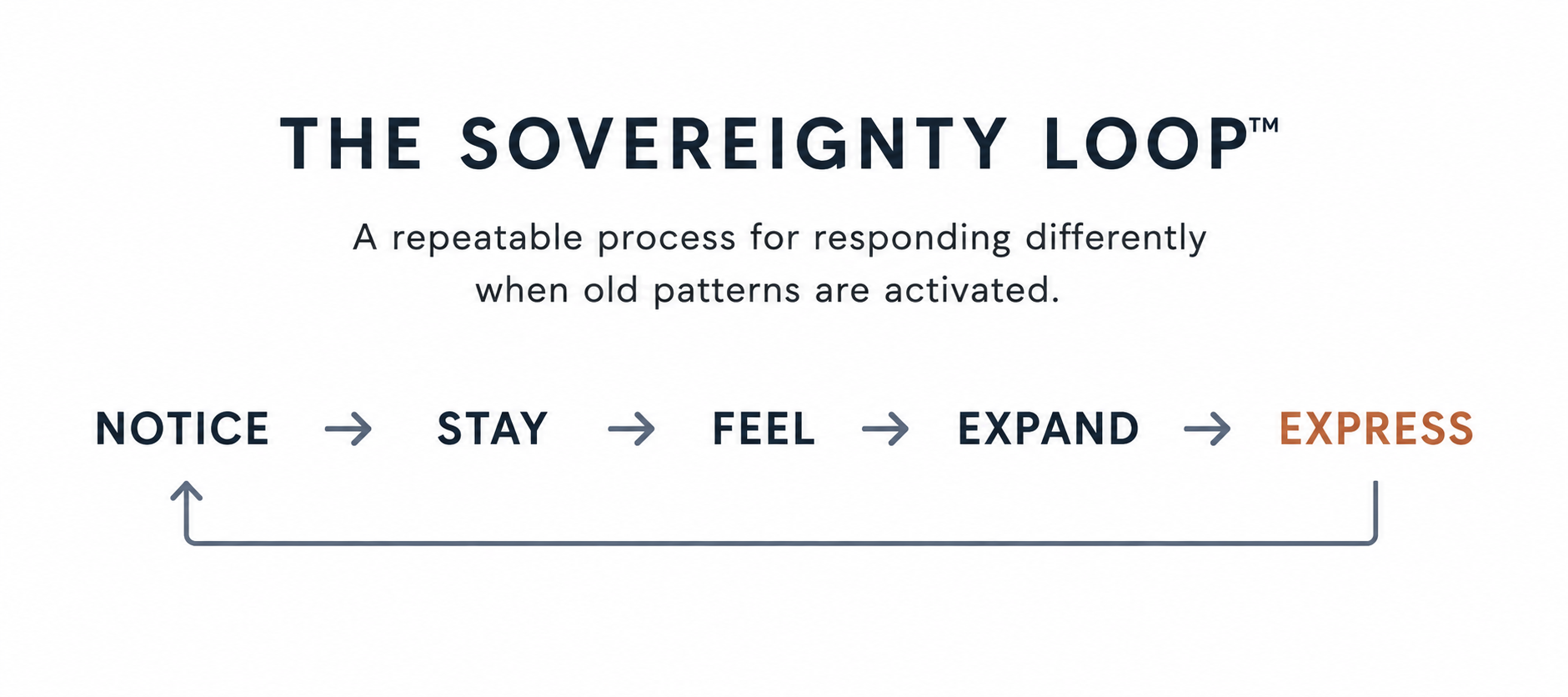
The Loop moves through five related capacities: Notice, Stay, Feel, Expand, and Express. It is not a rigid sequence and it is not a demand to push through discomfort. It offers a way to recognize an automatic protective response, remain connected to ourselves long enough to understand what is happening, and create more room for a chosen response.
Sometimes what emerges is a yes, a request, a story, a creative act, or a willingness to be seen. Sometimes it is a no, a boundary, a decision to slow down, or the recognition that a situation is not safe enough. Authentic expression is not saying everything to everyone. Sovereignty includes deciding what is ours to share, with whom, when, and in what form.
This becomes especially important in what I think of as “Cost Moments”: situations where expressing ourselves authentically feels as though it might put something important at risk. We may fear rejection, disapproval, embarrassment, conflict, or the loss of connection. These are often the moments when familiar protective patterns take over and we begin editing ourselves, performing for acceptance, or withdrawing from what we actually want.
The Sovereignty Loop gives us a way to recognize those reactions as they arise. Rather than automatically following them, we can remain present long enough to understand what we are experiencing and consider what feels genuinely right for us. The aim is not to eliminate discomfort or force ourselves to be more expressive. It is to expand our capacity to remain authentic even when doing so feels difficult.
We may draw on confidence, openness, or personal power we have experienced through pleasure. Or we may simply practice staying connected to ourselves during uncertainty, vulnerability, or conflict. The work is not to reproduce an erotic state in every part of life. It is to remember that the capacities revealed there belong to us, and to explore how they might inform a conversation, a relationship, a creative choice, or a moment when attention turns toward us and the old urge to disappear returns.
Sovereignty is not about expressing more of ourselves in every situation. It is about remaining connected to who we are, especially when authenticity feels costly, and choosing how we want to show up.
Living What We Already Know
The freedoms available to many queer people today offer extraordinary opportunities to shape our relationships, explore our sexuality, express our desires, and create lives that reflect who we actually are. Yet we don't always have the role models, positive media portrayals, or societal support to help us navigate those possibilities. In many ways, we're still figuring out what a fully expressed queer life might look like, making it up as we go along.
Even with those freedoms, we may also find ourselves holding back. We may still experience shame, uncertainty, or the familiar impulse to retreat into protection. Sovereignty does not require those reactions to disappear. It asks whether we can become more conscious of them and develop a greater capacity to choose how we respond.
What fascinates me is that we may already know much more about freedom than we realize. Our experiences of pleasure, connection, confidence, and authentic expression have given us glimpses of what becomes possible when we feel present in our bodies and comfortable being ourselves.
The opportunity is to bring more of that understanding into the choices we make every day. Not to become someone different, but to recognize and develop the capacities that can help us create lives more fully our own.
Our most expansive experiences do not reveal someone we need to become. They remind us how much of ourselves is already here.
Perhaps the greater invitation of the Queer Sovereignty Method is to discover just how much of that freedom we can choose to live, right now.