The Method

Knowing what’s true is one thing. Building the capacity to live it is another.

Queer Sovereignty Method is a practice for building your capacity to stay present with what you’re experiencing, feel more of what’s actually there, and express yourself with greater freedom and choice.

Stay present. Feel fully. Express what’s true.Especially when something is at stake.

Where the work begins

Insight is not the same as capacity.

Growing up gay, many of us became highly attuned to how we were being perceived. We learned what drew approval and what risked rejection—what could be expressed and what needed to be hidden, softened, defended, or carefully managed.

You may still recognize that instinct.

You walk into a room and start scanning for where you fit. You know what you want to say, but hear yourself softening it. Someone you’re attracted to shows interest, and suddenly you’re more aware of how you’re being perceived than of what you’re actually feeling.

These aren’t necessarily conscious decisions. Shame, repression, and years of adapting can become embodied patterns: contraction, vigilance, self-monitoring, inhibition, performance, or disconnection.

You can understand those patterns and still find yourself inside them.
Insight matters. But insight is not the same as capacity.

The proposition

From adaptation to capacity

Most of these responses began as intelligent adaptations. Some of us learned to contract—making ourselves smaller, quieter, or less visible. Some of us learned to compensate—performing, achieving, intensifying, or becoming more of whatever seemed likely to earn approval, attention, safety, or belonging.

Often, we learned to do both.

What began as adaptation can become an embodied pattern—and sometimes be mistaken for our personality.

Queer Sovereignty Method begins with a simple proposition

And because these patterns were learned, they can be relearned. With practice, the body can become less anxious about what once felt threatening, old responses can begin to relax, and we can become less likely to return automatically to familiar patterns of avoidance, inhibition, or performance.

In practice

Imagine noticing yourself contracting or overperforming in one of those moments—and instead of immediately following the familiar pattern, staying there a little longer.

You notice the impulse to please, perform, defend, retreat, push harder, or reach for more. You notice what you’re actually feeling—and perhaps what you actually want.

Nothing has to disappear. But suddenly, there is a little more room.

The goal isn’t to eliminate shame, override fear, or reject the strategies that once helped us navigate the world. It is to expand your ability to remain connected to yourself when those familiar responses arise.

  • More room to feel.
  • More room to discern.
  • More room to choose.
  • More room to express.

The practice

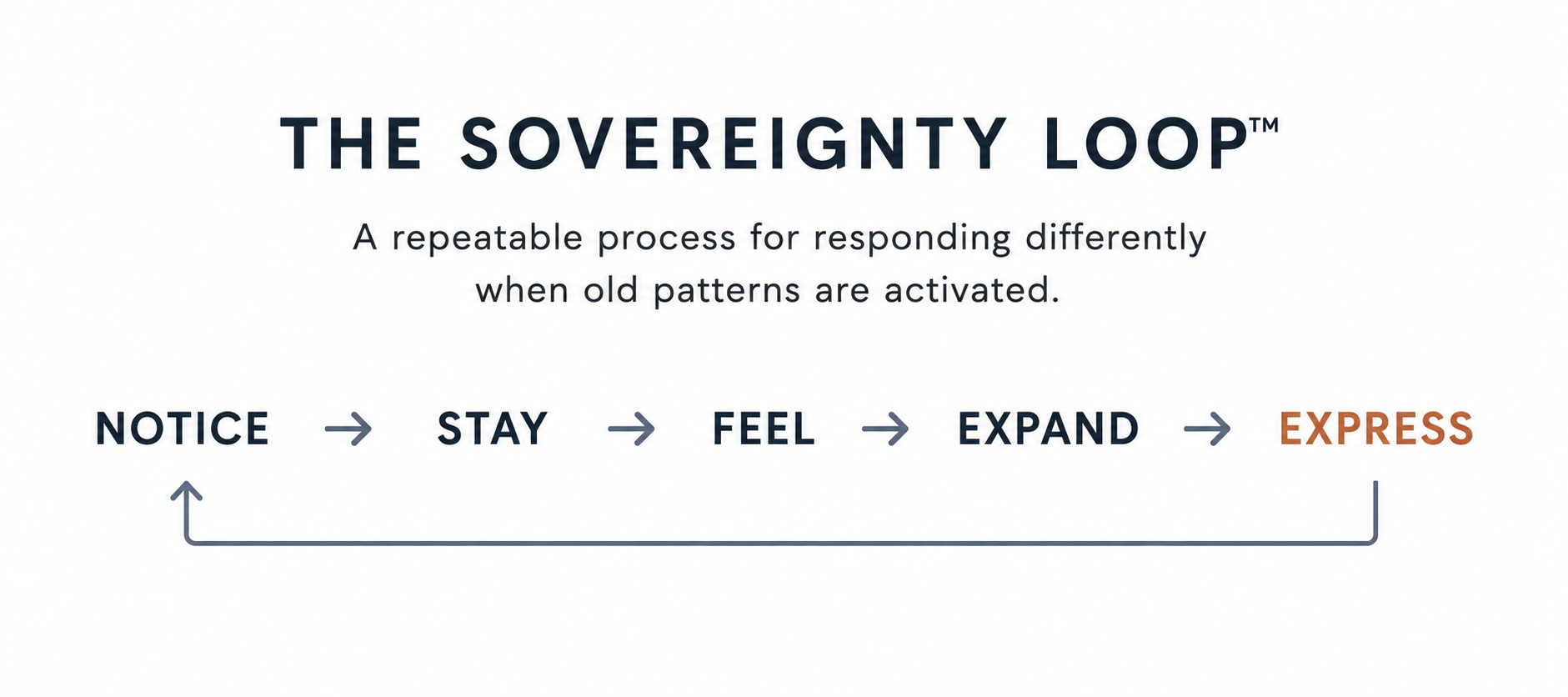
The Sovereignty Loop

The Sovereignty Loop is a simple map for practicing that movement.

The Sovereignty Loop: notice, stay, feel, expand, express — a repeatable practice for expanding what you can stay with, experience, and express.
  1. Notice

    Awareness

    Recognize what is actually happening.

  2. Stay

    Presence

    Remain connected rather than automatically leaving yourself.

  3. Feel

    Experience

    Allow more of what is actually present.

  4. Expand

    Capacity

    Create more room for the experience without needing to immediately change it.

  5. Express

    Action

    From that greater connection, discover what wants to be said, requested, chosen, declined, or revealed.

The practice is to make more of these capacities available when they matter most.

Cost moments

When something is at stake

I think of these as cost moments—moments when being fully yourself carries some perceived risk.

  • Being seen
  • Attraction
  • Conflict
  • Desire
  • Uncertainty

You want to tell someone you’re attracted to him and don’t know how he’ll respond. Your partner says something that lands badly and you can feel yourself preparing your defense before he’s finished talking. You disagree with someone you respect and hear yourself beginning to soften what you really think.

Or something wonderful is happening. Someone wants you. You’re receiving attention, affection, pleasure, or an unexpected opportunity—and you discover that getting what you want can make you feel vulnerable too.

These are moments when knowing and living can separate. They’re also where capacity can grow.

Sovereignty means becoming increasingly able to stay connected to yourself while the outcome still matters.

Pleasure

Pleasure as a place to practice

Embodied pleasure has always been an important part of queer exploration and expression—through sexuality, sensuality, kink, intimacy, touch, desire, and connection.

It also gives us space to play with different roles, energies, and relational dynamics—to explore leading, surrendering, giving, allowing, expressing, or being seen in ways that may not be available elsewhere.

In pleasure—alone or with another person—we can become more present, embodied, connected to breath and sensation. Sometimes that presence deepens into flow, or even ecstasy.

For gay men who may have learned very different messages about our bodies, desires, or worthiness, pleasure can offer a powerful counterexperience. We can believe what is actually happening now—the pleasure, desire, connection, affirmation, or freedom—while loosening our belief in what we were once told about ourselves or the stories we learned to carry.

We don’t simply understand a different story about ourselves. We get to experience it, feel it, and believe it.

Pleasure becomes a place to build capacity—and practice carrying it into the rest of our lives.

Pleasure isn’t only a place to feel differently. It can be a place to try being differently.

Two ways into the work

Queer Sovereignty Method is interested in both: becoming freer where you have been constrained, and discovering what becomes possible as that freedom grows.

Healing

Maybe there are places in your life where shame, repression, fear, inhibition, or past experience still constrict what feels possible.

Here, the work is about developing capacity where freedom has been limited—allowing more of yourself to become available for connection, pleasure, choice, and expression.

Expansion

Or maybe you already feel confident, experienced, connected to yourself, and genuinely fulfilled.

You’re not trying to fix anything. You’re curious about what becomes possible with greater presence, embodiment, discernment, pleasure, connection, or expressive range.

The work isn’t about repairing a wound. It’s about expanding capacity.

More freedom to be who you are.

Sovereignty isn’t invulnerability.

You can feel shame. You can want someone’s approval. You can get activated in conflict. You can care deeply about what another person thinks. You can be changed by intimacy, love, rejection, desire, and connection.

The goal isn’t to become unaffected by any of it.

  • More ability to remain present.
  • More access to what you actually feel and want.
  • More discernment about what nourishes you.
  • More choice about what you do.
  • More freedom to express what is true.

Sovereignty is not freedom from being affected. It is greater freedom in how you meet what affects you.